Leaders Have More Than More Knowledge
In the age of access to all the world's insight just a prompt away - what do you need to be a leader?
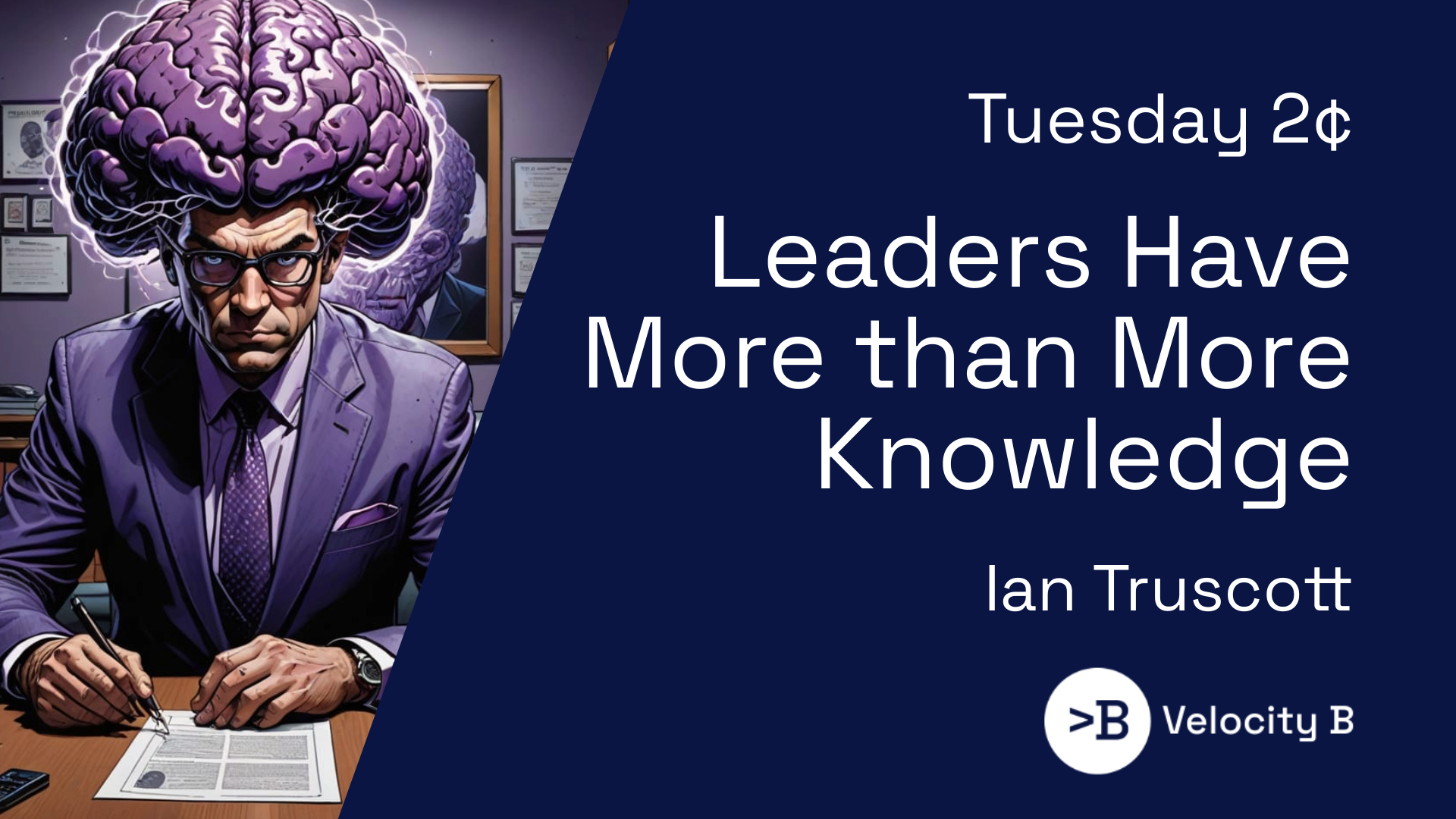
There is a lot of chatter right now about how generative AI is disrupting knowledge work, both at the coal face of creation, our copywriters and designers, but also our leaders, advisors, strategists, and consultants.
What is to become of those leaders, both of the “thought” kind and those at the upper end of the org chart, when the people they lead or advise are seemingly now within a carefully crafted prompt of all the insight in the world?
Yep, knowledge work has changed.
What once meant sifting through 47 tabs and half a dozen dead-end Google threads, our research now arrives neatly packaged and perfectly readable, unleashing a new era of Dunning–Kruger, where an ego-boosting, confident AI answer is apparently all it takes to feel like an expert.
And this, apparently, is a threat.
But is leadership, advisory, or consulting just about having more knowledge?
As a manager, it’s usual for me to have people on the team who know a shit load more than me on a topic, arguably most topics, that’s the point of teams.
And which consultant has not had the experience where you present something to the client's leadership team and a room full of their people, to have one of their subordinates pull you aside over coffee or a beer, and complain that they knew that, but the boss you just presented to, who was nodding along, didn’t listen to them.
And when you are mentoring or coaching, how often are you telling someone what they already know, or when you are being coached, you know that you know, you just need to be held accountable.
And there is a button in my accounting software that calculates and automatically files my sales taxes, but I pay someone at my accountant’s office to press it.
Why?
Because, sure, having knowledge is part of the mix of being an expert and a leader, but it’s really about trust, credibility, and sharing risk.
As a leader, synthesising that knowledge into a decision to give someone direction so they don’t have to decide, and taking on the FOFU (Fear Of F**king Up) from a colleague or a boss.
As a consultant or advisor, the subject matter expertise is delivered with the credibility of experience, the reassurance that you’ve seen this all before, again, arbitrating risk.
And, the tax submit button, well, I really don’t want to fuck up my taxes, that’s how they got Jimmy Carr and Al Capone.
It is, as is often the case with these AI conversations, about the human in this new synthesised knowledge age.
It is about how we use this new tool, this knowledge and our experience - what do we bring to this transaction?
Care, trust, accountability and credibility.