Stealing The Joy of Work
We steal the carpenter's joy every time we open a flat-pack box and find the Allen key. This week's Tuesday 2¢ asks whether AI is about to do the same to knowledge workers.
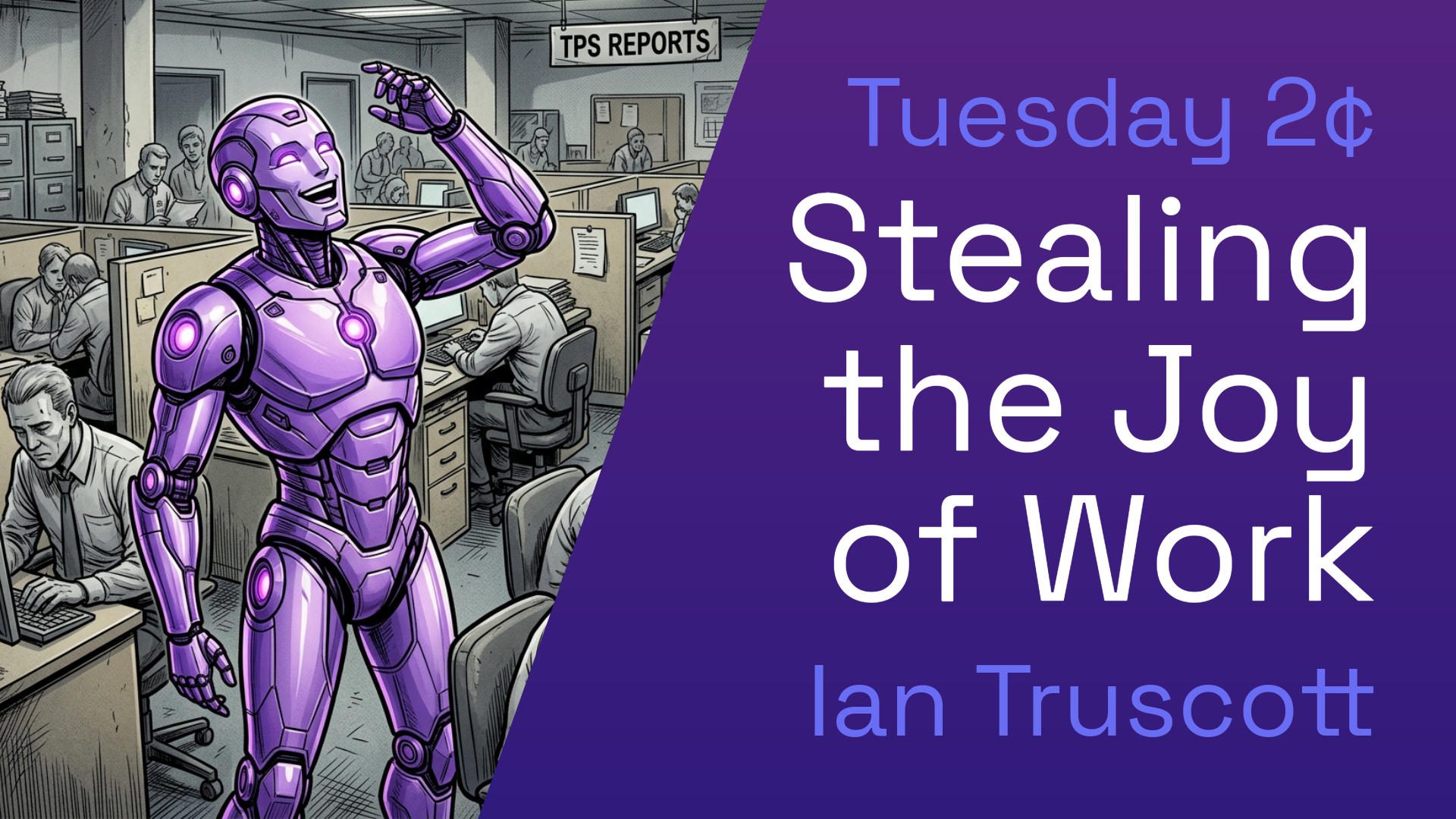
We steal the carpenter's joy every time we open a flat-pack box and find the Allen key. This week's Tuesday 2¢ asks whether AI is about to do the same to knowledge workers.
It used to be that coming home from work and getting changed meant the end of the working day. The mere act of being at work, the journey, being out of the house, felt like an achievement, however productive the day really was.
There was a baseline level of satisfaction that something got done, regardless of how unsatisfying that thing was. Even today, if I go to a meeting in London, rather than a virtual meeting, somehow it feels like something significant got done.
That’s changed, of course, and not just because of remote work. For years, mobile phones and laptops have rubbed away at that line, and if you’re reading this, you’re probably an always-on knowledge worker.
The satisfaction is now in the work: those moments of flow, figuring something out, helping someone, all the little wins and dopa-hits during the day. It’s not enough to have had the laptop open or sat at a desk for 8 hours. And most of us, in the age of the hustle, struggle to know when the work is done.
And along comes AI with its promise of productivity. But, as I asked in a LinkedIn comment on last week’s post, is it going to take away the fun stuff, the dopa-hits that replaced the satisfaction of the physical 9-5?
Spending an afternoon (or maybe working into the early hours) working some shit out, or creating something, might be frustrating at the time, but there is a joy in it when the problem is solved.
I’ve heard that software developers are missing that hit. At the end of the day, there are hundreds of new lines of code they’ve checked in, but in an AI-augmented work world, how much of it is theirs? What problem did they solve - one they can be proud of? Or, knowing some developers I’ve known, one they can smugly brag about?
You don’t get pride when AI does it for you.
Maybe knowledge work is going the way of the factory. The difference in job satisfaction will be like that between a carpenter crafting a bespoke table and being the operator on a factory line screwing the 100th identical leg into the 100th identical table top.
Both are making tables, but where is the joy?
There’s the obvious exception of artisanal or bespoke creative work, like writing this, where I choose the hard way. Sure, I have AI sitting next to me as an editor, but I’m doing the writing. I need to bash my head against this idea and risk making a bit of a cock of myself sharing it with you.
But for everything else?
The joy is going to be in the design of the thing, the design of how the parts fit together, the design of the process by which it is made and the design of the factory in which it is made, not the automated making. Unless 8 hours of the knowledge worker’s equivalent of the 100th table leg is your thing, where will the joy be?
Maybe that’s because we don’t value automated work.
This week I learned about the chained library in Hereford Cathedral, which is full of priceless medieval books that are chained to the shelves. Apparently, the manuscripts, those that were written by hand, are the ones visitors are drawn to, not the printed ones, even though they’re rare and old too.
As plenty of commentators are commenting when it comes to AI, people ultimately prefer the bespoke and handmade, but do they buy it? We can’t all be artisans; as any carpenter will tell you, the market for bespoke is limited; we consumers steal their joy with a mass-produced box of bits and an Allen key.
Henry Ford is not famous for being a machinist and steam engineer who built his first steam engine at 15; he’s famous for seizing the moment of automation and disrupting the whole business of the horseless carriage.
In the same way that we can’t all be artisans, we can’t all be innovators and designers either, or at least not all of the time. I don’t know where the joy goes when knowledge work becomes factory work.
Does anyone? We’ve talked a lot about the atrophy of skills, and I suspect an atrophy of job satisfaction is coming with it - if AI steals the joy of work.
What do you think?