Metrics Maketh the Meh
This week, inspired by missing a week, a philosophy professor, and a goal to be mildly profane....
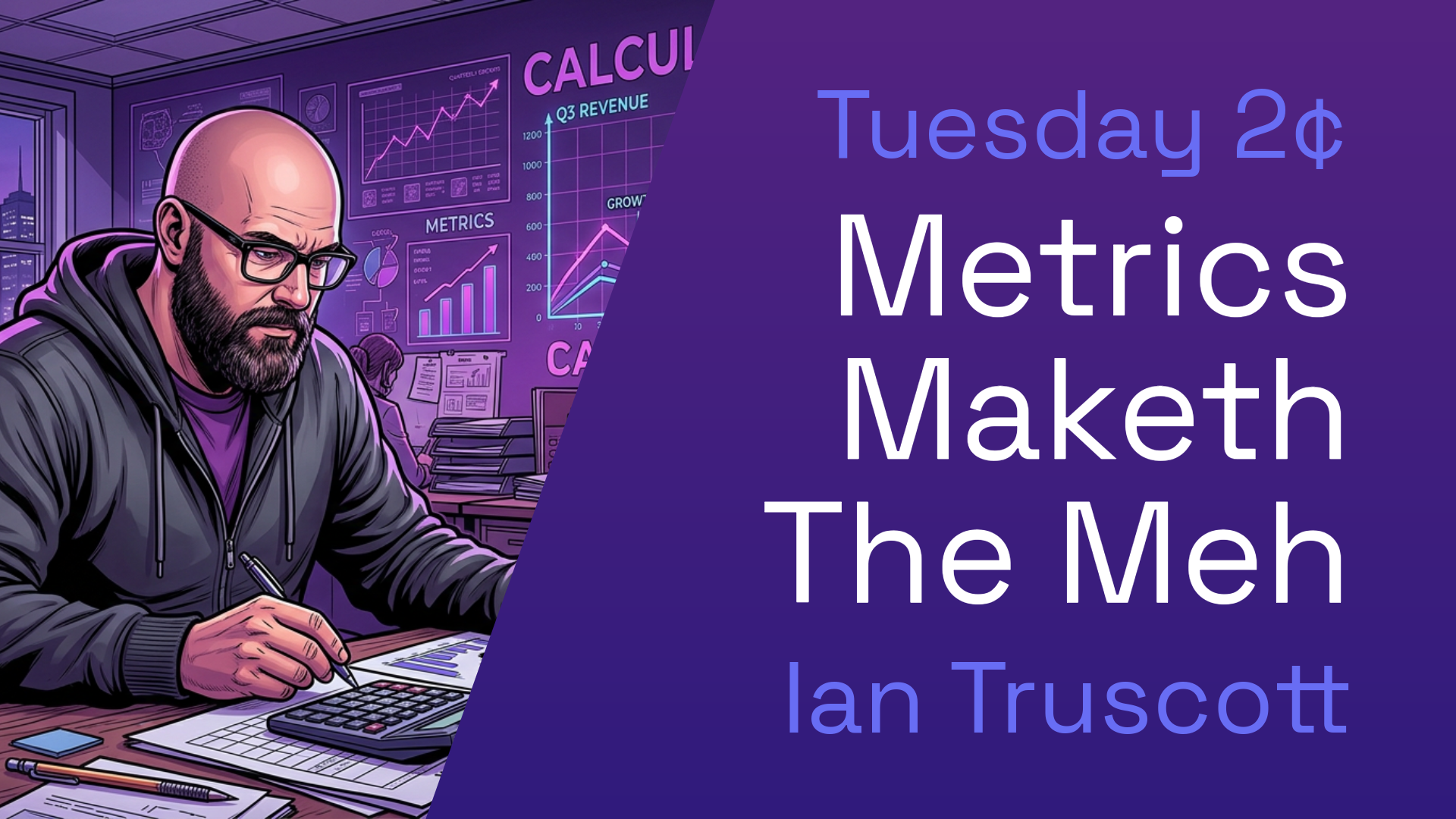
This week, inspired by missing a week, a philosophy professor, and a goal to be mildly profane, I ask if we are giving up our reasoning to value capture.
You may recognize this. You start a content project motivated by doing the work, exploring and sharing ideas, a thing you valued for the creative process, or how it might help someone, only for the value of that to drift to hard numbers like likes, downloads, comments, and views.
I came across a term for this from a philosophy professor, C. Thi Nguyen, who has coined the term “value capture” which he describes as follows:
Value capture occurs when an agent’s values are rich and subtle; they enter a social environment that presents simplified — typically quantified — versions of those values; and those simplified articulations come to dominate their practical reasoning.
In that, we shift from the softer, qualitative motivations for doing something that are difficult to measure to quantitative metrics we can easily see.
He uses examples such as Fitbit’s step counts, social media likes and shares, citation rates, ranked lists of the best schools, and Grade Point Averages.
Putting a number on things makes it simple to compare and aggregate across different organizations, but it comes without context - the why something happened gets scrubbed away.
In the case of this Tuesday 2¢, the fact that I publish every Tuesday is easy to measure and could drive my behavior.
When I miss a week, like I did last week, my internal passive-aggressive Duolingo-like beast nags away at me for breaking my streak, and maybe I feel compelled to write something a bit shit to tick that box.
And clearly, writing something I think is a bit shit (you judge for yourself) would be against my values and a classic example of value capture, as the qualitative thing - how I feel about the writing and my journey to express the idea - would have been overwhelmed by my internal quantitative metric to publish every Tuesday.
As it happens, last Tuesday I was at a funeral and a wake, and I had no chance, logistically, of publishing on Tuesday. And the reality, as I juggled work and a family bereavement, was that I really had nothing vaguely entertaining and snarky to share about marketing. I could have done some Wednesday wank (sorry I couldn’t resist the alliteration), to keep the weekly streak alive, but my heart wouldn’t have been in it.
It is at this point that I say that marketing is a slave to the quantifiable, but hey, we all know that.
What's more interesting is the other choice I had.
I probably could have let AI phone something in for me, something that would have ticked the quantifiable publish on a Tuesday box, and maybe even it could have been highly optimized to attract the most views, likes, and shares - possibly outperforming this human.
Why not?
Well, I’d have hit the quantitative target (weekly post done), but aside from the result being a bit “meh”, I would have missed the qualitative goal of this thing - doing the work to birth an idea, the joy of finding a way to write “shit” and “wank” in a marketing context that might solicit a genuine human reaction to me (not my indentured robot) writing “wank”.
I’ve talked (here) about generative AI robbing us of the creative journey of writing, the value of forming ideas as we go through this process, and the deliberation, taste, and discernment that go into writing and publishing even a slightly shit weekly column, let alone the good stuff.
But if you are a slave to value capture, it’s likes, shares, and vanity metrics all the way, never mind deliberation, taste, and discernment - is it popular?
Recently in his Tilt newsletter, Joe Pulizzi asked:
What if great content only needs to answer two questions?
- Does creating this bring something good into my life? - Does it give me energy? Does it make me curious? Does it help me understand something? Would I still want to make it if nobody was keeping score?
- Does it make someone else’s life better? - Does it solve a real problem? Help someone see differently? Make them laugh? Give them hope? Help them make a better decision?
I loved this, but how do you stick a metric on it?
You don’t, and that’s the whole point.